
Assessment and Evaluation

Helping families understand evaluations and next steps
Navigating evaluations can feel overwhelming. Families often encounter unfamiliar terms, conflicting information, and pressure to “choose the right evaluation” before they fully understand their options.
At Bright Futures Neurodevelopment, our goal is to help families make sense of evaluations, understand what different evaluations are designed to answer, and feel more confident taking next steps. You do not need to have everything figured out to get started.
Why Families Seek Evaluations
Evaluations are used to better understand a child’s strengths, needs, and development. Families may seek evaluations to:
Better understand learning, behavior, or emotional concerns
Explore neurodevelopmental differences such as autism or ADHD
Guide educational planning and supports
Access therapies or services that require documentation or diagnoses
Clarify questions that arise during transitions or developmental changes
Evaluations are tools to support understanding and planning — not labels or predictions about a child’s future.
What Evaluations Can (and Can’t) Do
Evaluations can help answer specific questions about development, learning, behavior, or emotional functioning and can guide recommendations and supports.
Evaluations cannot automatically guarantee services, replace ongoing support, or capture everything about a child in a single snapshot. Different evaluations answer different questions.
Common Types of Evaluations Families Encounter
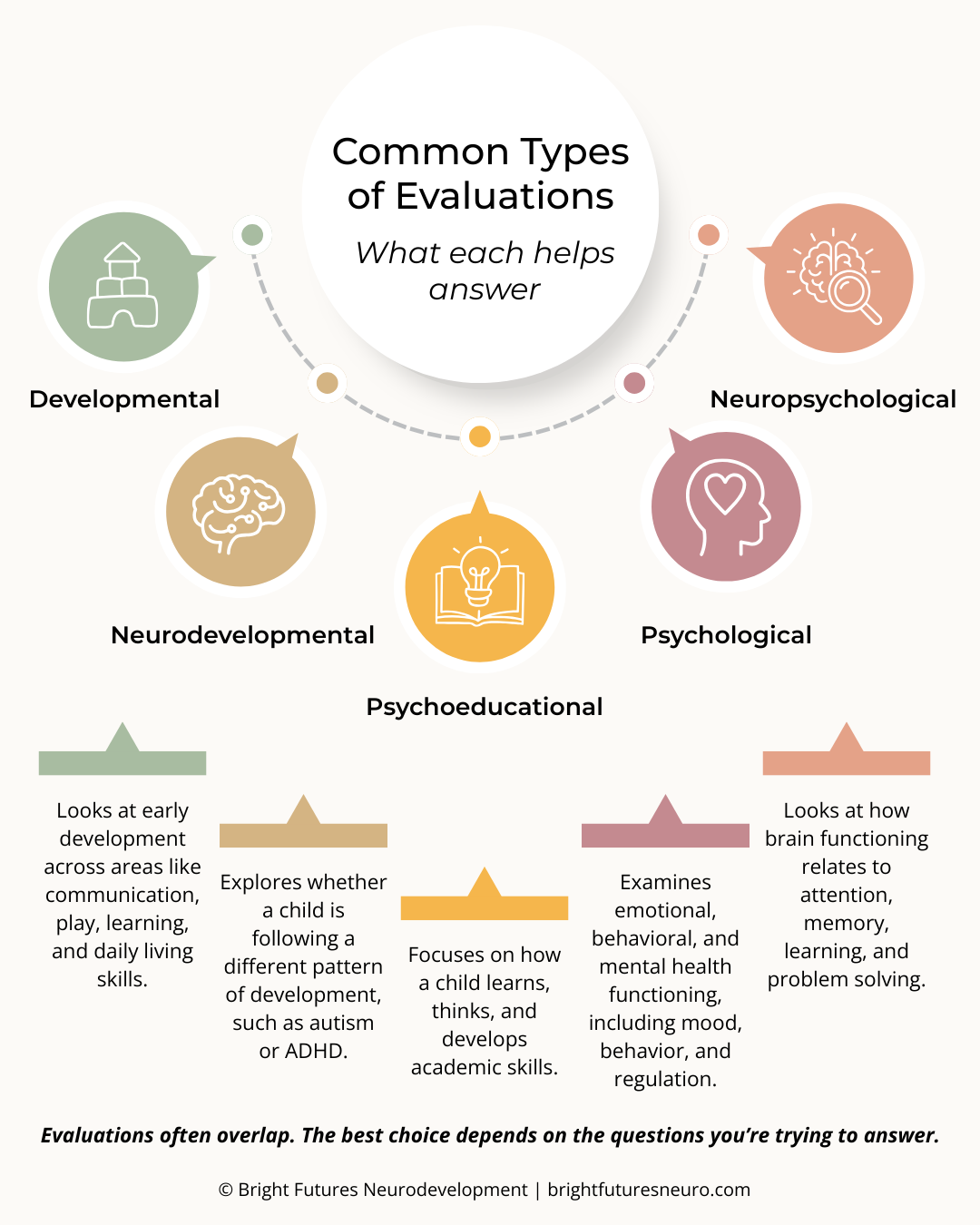
Families often hear many different terms when exploring evaluations, and the overlap can be confusing. While evaluations vary by provider, most fall into a few broad categories. These categories often overlap and are chosen based on the questions being asked, not just a child’s age.
A helpful way to think about these evaluations is:
Developmental = how a child is growing and developing over time
Neurodevelopmental = whether a child is following a different neurodevelopmental pattern
Psychoeducational = how a child learns
Psychological = how a child feels and acts
Neuropsychological = why the brain works (or doesn’t) that way
-
Developmental Evaluations
Developmental evaluations focus on early developmental skills across areas such as communication, play, learning, and daily living skills.
These evaluations are often used with infants, toddlers, and young children and may identify developmental delays or uneven development. They can be completed privately or through early intervention or school systems.
Think: Is my child developing as expected for their age?
-
Neurodevelopmental Evaluations
Neurodevelopmental evaluations focus on understanding whether a child’s development is following a different neurodevelopmental pattern.
These evaluations often explore areas such as social communication, attention, behavior, learning, and regulation, and may include assessment related to autism or ADHD. They can be conducted across the lifespan, including early childhood.
Think: Is my child’s development following a different neurodevelopmental pattern?
-
Psychological Evaluations
Psychological evaluations focus on emotional, behavioral, and mental health functioning.
They may examine mood, anxiety, behavior, emotional regulation, and attention, and are often used to guide mental health treatment and support planning.
Think: How does my child feel and act?
-
Psychoeducational Evaluations
Psychoeducational evaluations focus on learning, thinking skills, and academic development.
They examine how a child learns, processes information, and develops academic skills, and are commonly used to guide educational planning and accommodations.
Think: How does my child learn?
-
Neuropsychological Evaluations
Neuropsychological evaluations focus on brain–behavior relationships and how different brain systems are functioning.
They often examine attention, memory, executive functioning, learning, and processing skills and may be helpful when concerns are complex or span multiple areas.
Think: Why is my child’s brain working this way?
A Note About Overlap
Many evaluations include elements from more than one category. The most important factor is not the name of the evaluation, but whether it matches the questions you are trying to answer and is conducted using developmentally appropriate, evidence-based practices.
You don’t need to know the “right” evaluation name to take the next step. Clarifying your questions is often more important than choosing a label.
School-Based vs. Clinical Evaluations
Families often encounter both school-based and private/clinical evaluations. While they may assess similar skills, they serve different purposes.
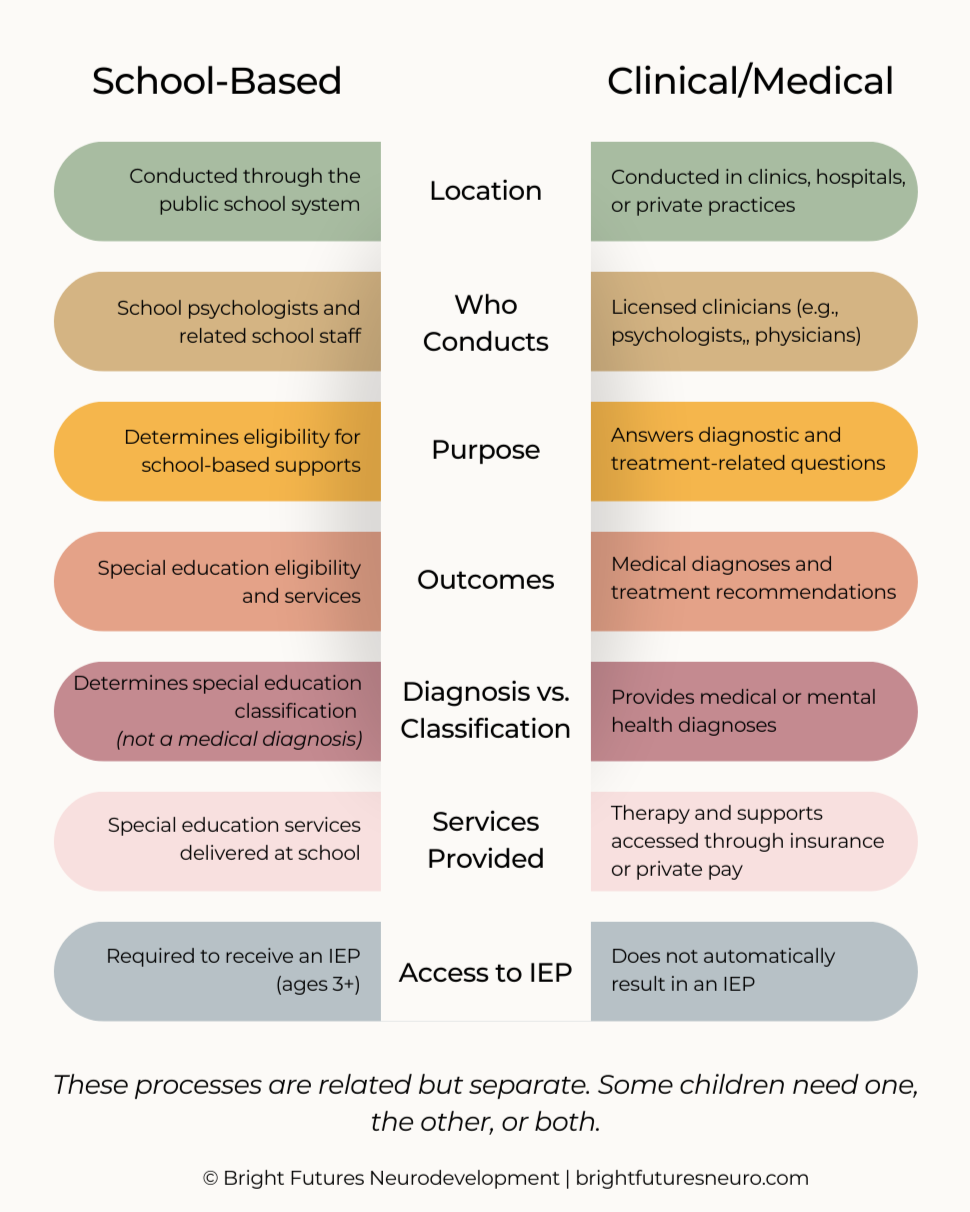
A medical diagnosis and an IEP are related but separate processes that serve different purposes and lead to different types of services.
A medical or clinical diagnosis may help families access:
Insurance-covered therapies
Community-based supports
Private services and treatment planning
An IEP provides:
School-based special education services
Educational supports and accommodations
Services delivered within the school setting
A child may have one without the other, and having a medical diagnosis does not automatically mean a child will qualify for an IEP.
Who Conducts Evaluations
Evaluations may be conducted by different professionals depending on the type and purpose of the evaluation, including:
Licensed psychologists (psychological, psychoeducational, neuropsychological, and neurodevelopmental evaluations)
Developmental specialists (developmental evaluations)
School teams (school-based educational evaluations)
Understanding who conducts which evaluations can help families navigate next steps.
What to Look For — and What to Avoid — in Evaluations
Not all evaluations are the same. Understanding what to look for can help families choose evaluations that are meaningful, respectful, and truly useful.
What to Look For
A clear purpose
The evaluator takes time to understand your concerns and explains what questions the evaluation is designed to answer.
Evidence-based tools and practices
The evaluation uses well-researched assessments and methods that are appropriate for your child’s age and needs.
Multiple sources of information
High-quality evaluations combine standardized testing with observations, interviews, developmental history, and input from caregivers and teachers when appropriate.
Strength-based perspective
The report identifies strengths alongside challenges and avoids defining a child only by test scores or diagnoses.
Clear, understandable results
Findings are explained in plain language, not just test names and numbers.
Actionable recommendations
Recommendations are specific, realistic, and connected to everyday supports, services, or next steps.
Collaboration and consent
Families are treated as partners in the process, with transparency about what is being assessed and why.
Be Cautious About
Very brief evaluations for complex concerns
Quick screenings alone are usually not enough to answer questions about learning, development, or diagnoses.
One test = one conclusion
Be cautious if conclusions are based on a single measure without broader context.
Overly vague or generic recommendations
Statements like “monitor progress” or “consider supports” without specifics may not be very helpful.
Deficit-only language
Reports that focus only on what a child “can’t do” and overlook strengths can be misleading and discouraging.
Lack of explanation
If results are not clearly explained or families are discouraged from asking questions, that’s a red flag.
Promises of guaranteed outcomes
No evaluation can guarantee a diagnosis, services, or specific school placement.
A high-quality evaluation should help you understand your child better and guide next steps — not leave you more confused than when you started.

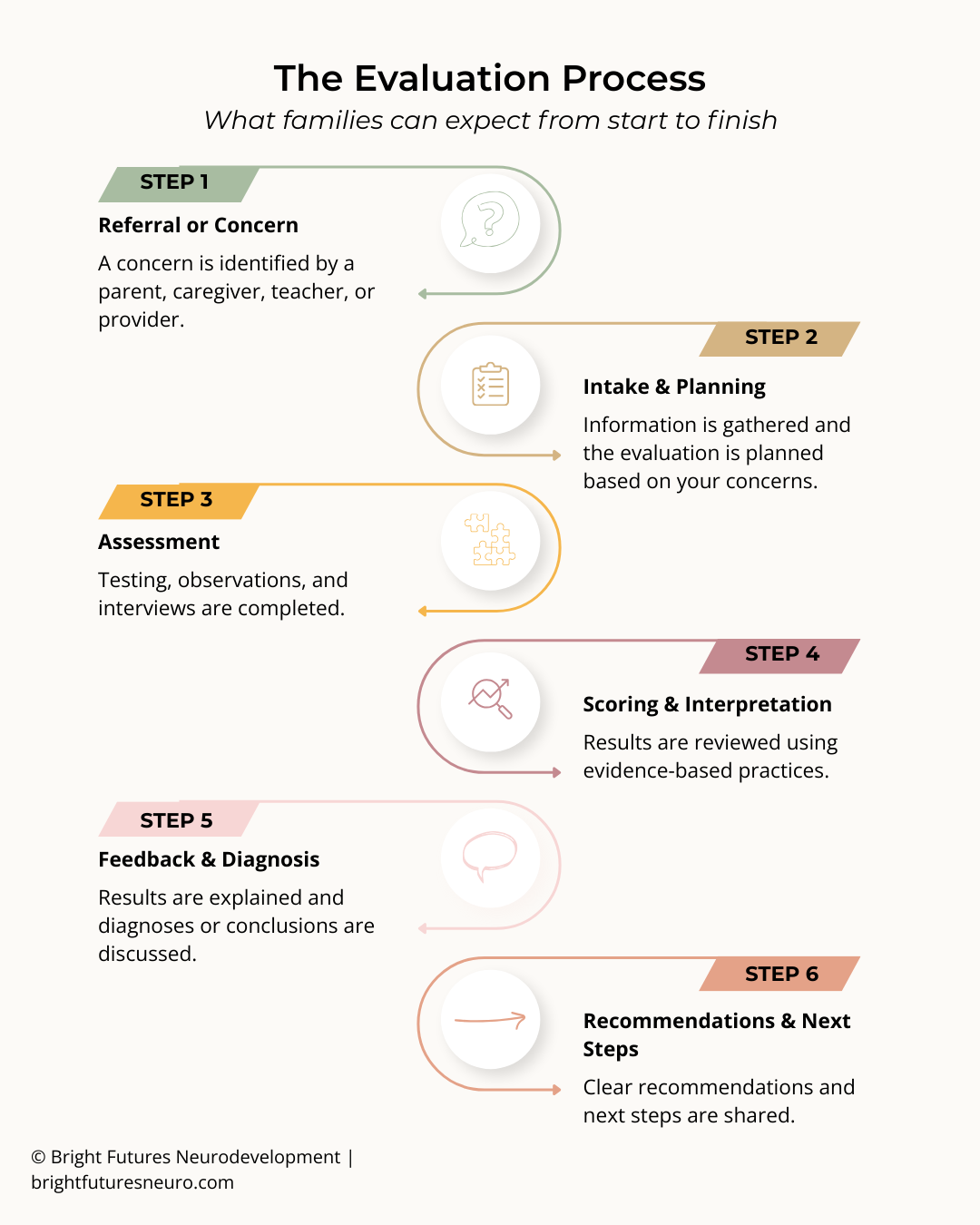
What to Expect from the Evaluation Process
Preparing for an Evaluation
Supporting your child while encouraging effort
Preparing for an evaluation is about helping your child feel comfortable, regulated, and ready to try their best. Thoughtful preparation supports more accurate results and a smoother experience for everyone.
What to Tell Your Child
Use calm, honest language that fits your child’s age and communication style.
For young children:
“You’ll meet with someone who helps kids learn and grow. You’ll do some talking, playing, and puzzles. I’ll be nearby.”
For school-age children:
“This helps us understand how you learn and think. There are no right or wrong answers — just try your best.”
For teens:
“This evaluation can help us understand what supports might be helpful at school or in daily life.”
Helpful guidance:
Avoid describing the evaluation as a test
Emphasize effort over performance
Let your child know breaks are allowed when needed
Medication Questions (Including ADHD Stimulants)
Many families ask whether their child should take prescribed ADHD stimulant medication on the day of an evaluation.
This decision should be discussed ahead of time with:
Your child’s medication provider, and
The evaluating clinician
The right choice depends on the purpose of the evaluation and the questions being asked. Avoid changing medication routines without professional guidance.
Fuel, Comfort, and Regulation
Basic needs can significantly impact attention, mood, and stamina.
Make sure your child eats beforehand
Bring snacks and water
Choose comfortable clothing
Bring glasses, hearing aids, or other supports
Comfort items (e.g., fidgets, stuffed items) can be helpful at any age, when allowed
Coaching Self-Advocacy (With Balance)
It’s helpful to coach children and teens to advocate for themselves during the evaluation.
Encourage your child to:
Ask for a break if needed
Request a snack or drink
Ask to use the restroom
At the same time, emphasize the importance of effort and persistence. Children should understand that supports help them do their best — not avoid tasks altogether.
You might say:
“If you need something, it’s okay to ask — and it’s also important to keep trying.”
Motivation and Regulation Strategies
If your child benefits from specific motivation or regulation strategies at home, consider discussing these with the evaluating clinician ahead of time.
Examples include:
Reward systems
First-then statements
Clear expectations with encouragement
Fidget toys (when appropriate)
Brief movement breaks to support attention and regulation
Sharing this information helps the clinician create an environment where your child can show their true abilities while maintaining the integrity of the evaluation.
For Parents and Caregivers
It’s normal to feel nervous. Remember:
Your child does not need to be perfect
The goal is understanding, not performance
Your input and observations are an important part of the process
Getting the Most Out of Your Child’s Evaluation
Your parent guide to preparing, participating, and asking questions
-
Jot down your top questions or concerns
Note what’s going well—not just challenges
Gather past reports, school feedback, or therapy notes
Reflect on when challenges show up (time of day, transitions, expectations)
-
Share context about behaviors (what happens before/after tasks)
Ask how tasks relate to real-life skills
Let the evaluator know if something feels unlike your child
Helpful question: “How does this task connect to home or school?”
-
What are my child’s strengths, and how can we build on them?
Are challenges developmental, situational, or skill-based?
What supports would help right now?
How confident can we be in these results given testing conditions?
What would progress realistically look like over time?
-
Ask for plain-language explanations
Clarify what findings do and do not mean
Discuss practical recommendations for home and school
Revisit results as your child grows — development is dynamic
An evaluation is a snapshot, not a prediction. Your voice matters before, during, and after the process.
Questions Parents Can Ask Before an Evaluation
To feel prepared, informed, and confident
You don’t need to know everything going into an evaluation. Asking a few thoughtful questions can help you understand the process, clarify expectations, and feel more confident supporting your child.
-
What questions is this evaluation designed to answer?
What concerns or diagnoses will be considered?
How will the results be used to guide supports or next steps?
-
What is your experience with children like mine?
What types of assessments are used, and are they evidence-based?
How do you adapt the evaluation for children who need breaks, movement, or extra support?
-
How long will the evaluation take?
Are breaks, snacks, or movement allowed?
Can my child bring comfort items or fidgets?
Should my child take prescribed ADHD medication that day?
-
How will my input be included?
Are parent interviews or questionnaires part of the process?
Can I share strategies that help my child stay regulated or motivated?
-
How and when will results be shared?
Will the feedback include clear, practical recommendations?
Will I receive a written report, and how detailed will it be?
-
How can the results be used to access supports or services?
Will the evaluation help with school planning or accommodations?
Can you help guide us toward next steps if additional support is needed?
A Gentle Reminder
It’s okay to ask questions. A high-quality evaluation should feel collaborative, transparent, and respectful of both you and your child.
Where to Start
Knowing where to begin can feel overwhelming. The right starting point depends on your child’s age, your concerns, and what you hope to access through an evaluation.
If You’re Concerned About Autism or Development
Families can explore evaluations through medical or clinical providers and private practices at any age. Clinical evaluations are appropriate even for young children and can address autism as well as other developmental, neurodevelopmental, neuropsychological, or mental health conditions. Families should contact specific providers to confirm the scope of assessments.
For young children, it can also be helpful to start with early intervention programs (birth–3) or school systems (ages 3+) to get a broad understanding of developmental progress and determine eligibility for educational supports. These programs do not provide medical diagnoses such as autism, but can help identify areas for support and intervention.
For families in Utah, this resource can help identify providers who conduct autism evaluations:
👉 Finding an Autism Evaluator in Utah
Note: Many of the evaluators listed conduct psychological, psychoeducational, and neuropsychological evaluations in addition to autism-specific assessments. Even if your concerns are not related to autism, but involve emotional, behavioral, or developmental questions, many of these providers can conduct evaluations to address those areas. Families should contact each provider directly to confirm the scope of their assessments.


A Final Note
Evaluations are not one-time events. Children grow, needs change, and questions evolve. Seeking clarity or reevaluation over time is a normal part of supporting a child’s development.
You don’t need all the answers to take the first step.
Printables
-
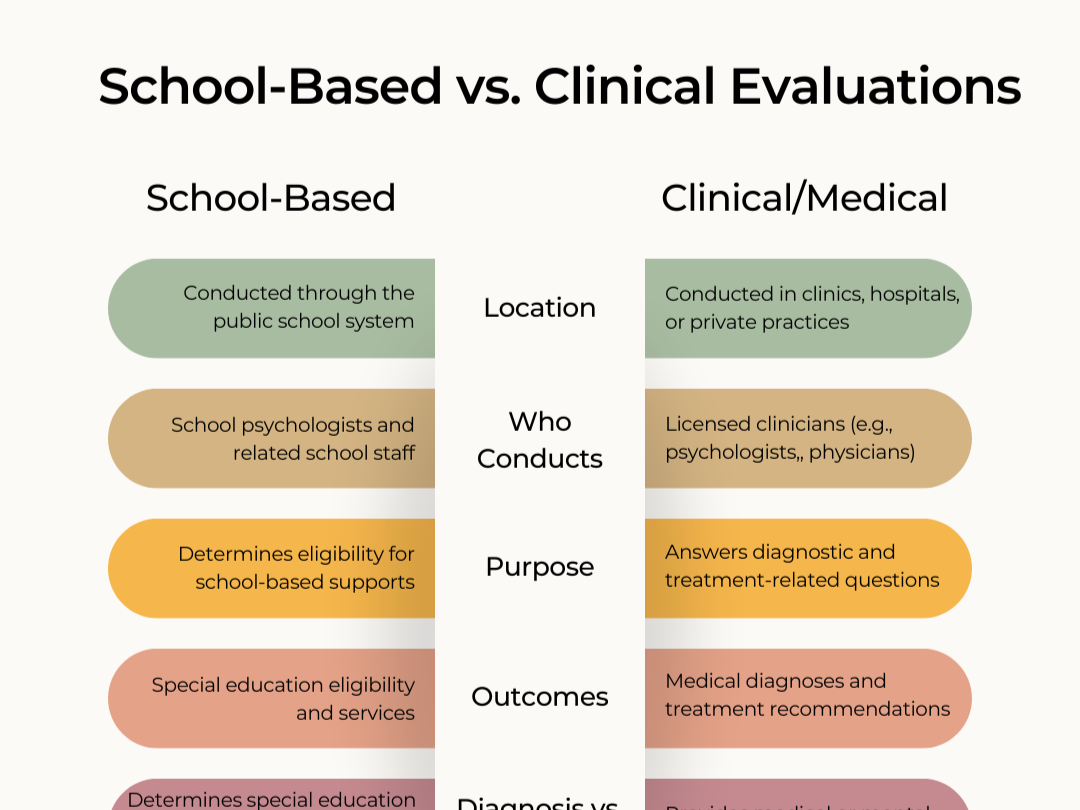
School-Based vs. Clinical Evaluations
See the key differences between school-based evaluations (to access educational supports) and clinical/medical evaluations (to get diagnoses and guide therapies), so you can better understand which might be right for your child.
-
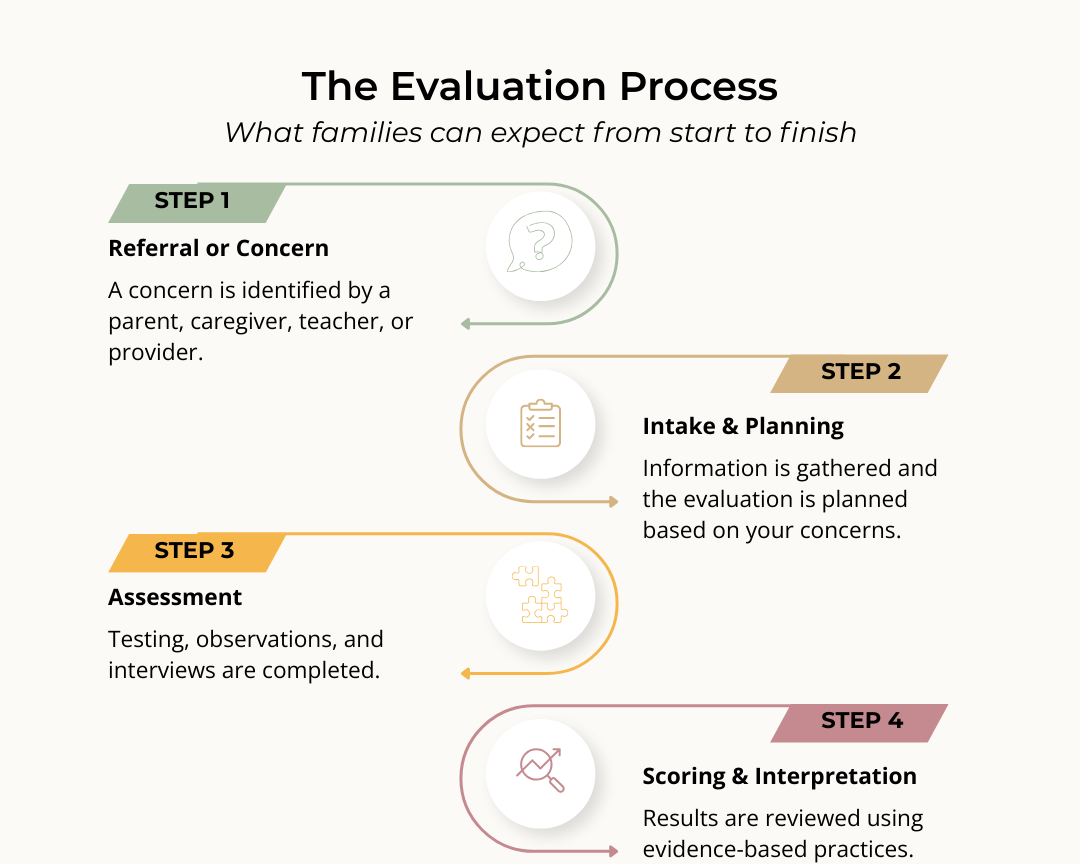
The Evaluation Process
This visual shows what to expect during a child’s evaluation, from referral and intake to assessment, feedback, and recommendations — helping families feel prepared and confident throughout the process.
-
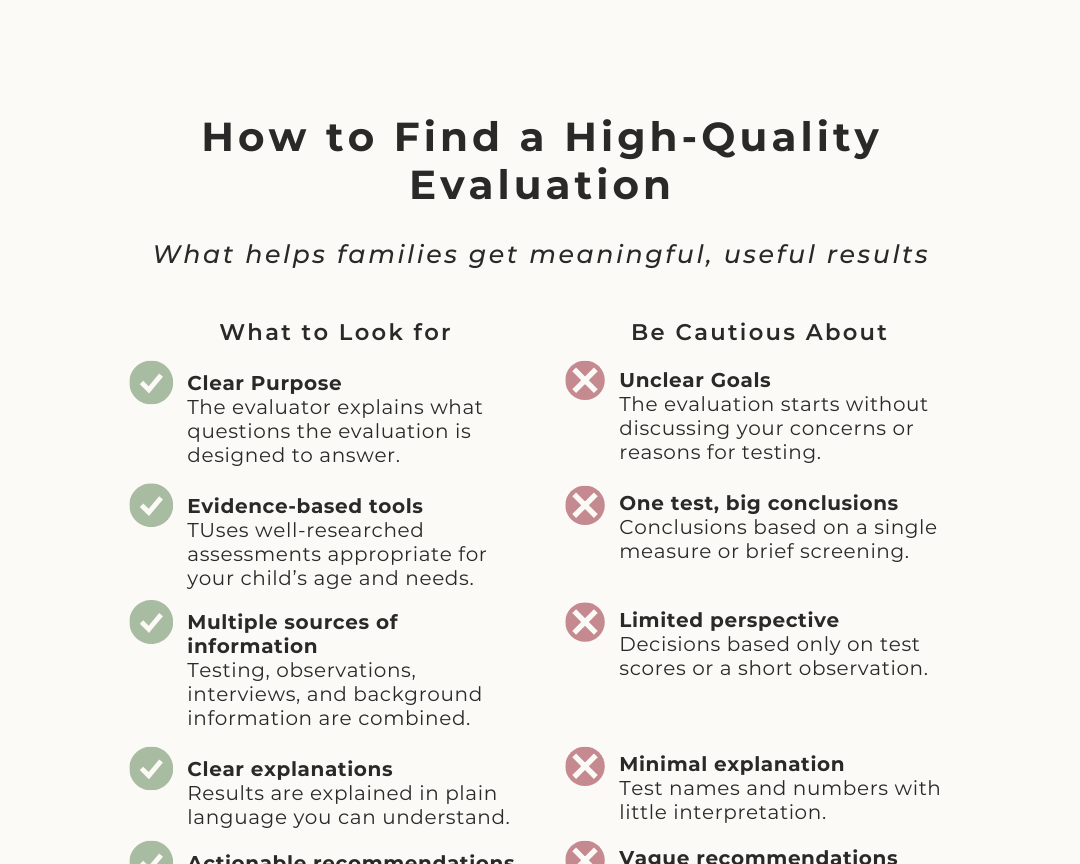
Quality Evaluations
See what makes an evaluation trustworthy and effective, and learn what to watch out for — helping you feel confident in choosing the right provider for your child.
-
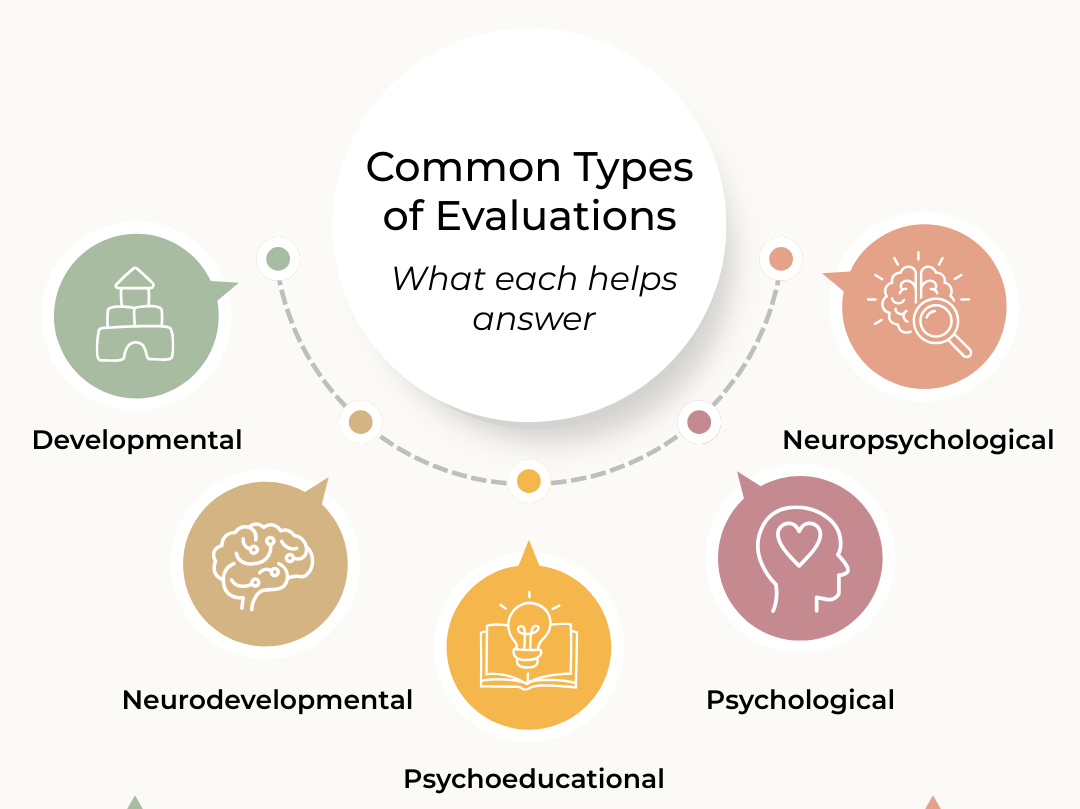
Types of Evaluations
This visual shows common types of evaluations — including developmental, neurodevelopmental, psychological, psychoeducational, and neuropsychological — so parents can see what each assessment focuses on and how it can help their child.
-
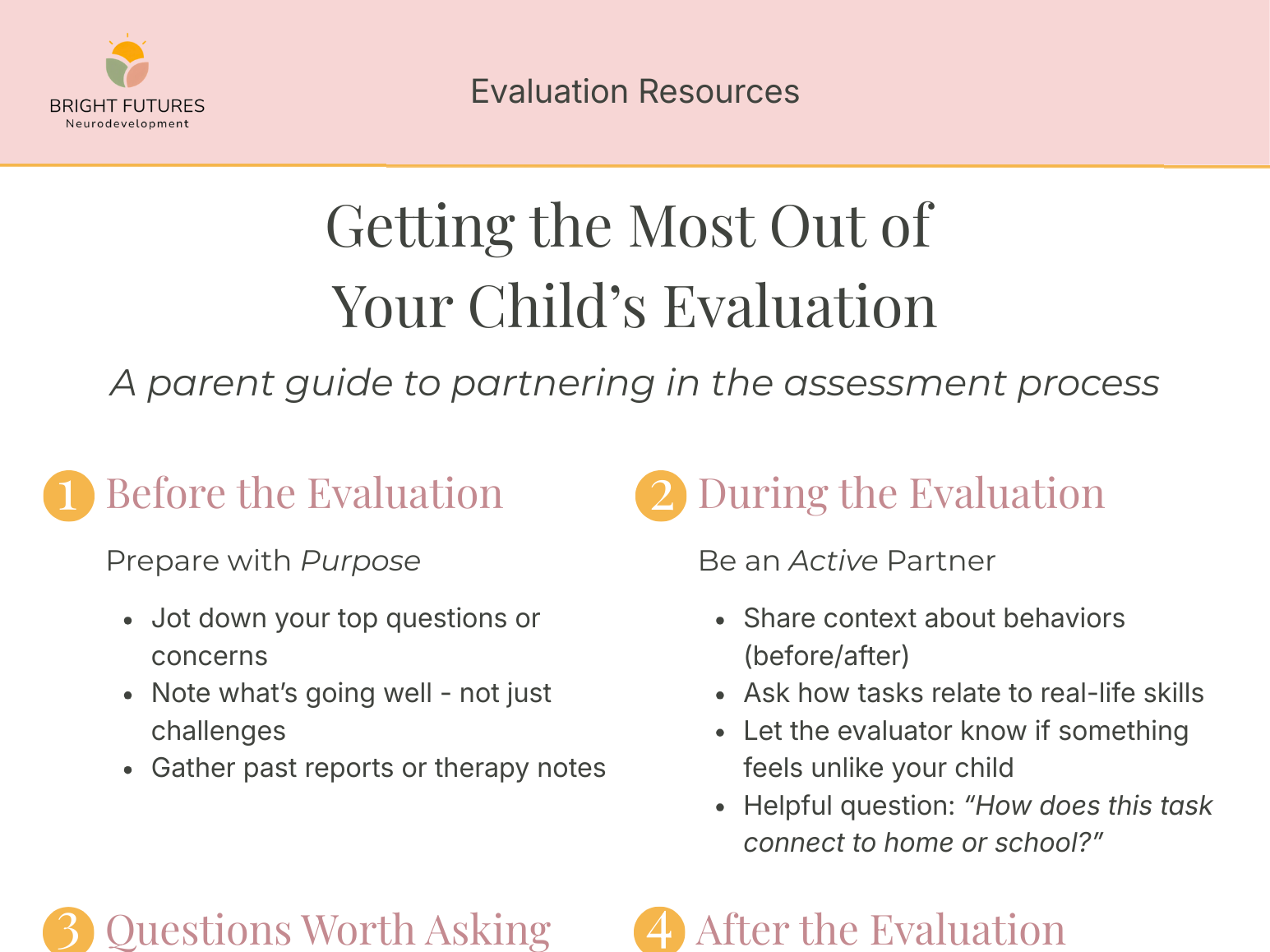
Getting the Most Out of Your Child's Evaluation
"Getting the Most Out of Your Child’s Evaluation" is a practical, parent-focused guide to help families prepare for, participate in, and understand their child’s assessment. With clear tips, key questions to ask, and guidance for before, during, and after the evaluation, this handout empowers caregivers to be active partners in the process and make the results meaningful for everyday life.